
How to Store and Handle Your GLP-1 Medication Safely
Quick Read
Most injectable GLP-1 pens arrive cold and need to stay refrigerated between 36 and 46 °F, never frozen. Once you take them out of the fridge, each medication has its own window for safe room-temperature storage, so the number of days you can safely carry one differs product to product. Inspect every shipment when it arrives, keep pens in their original carton, mark your first-use date, and reach out to your pharmacy right away if a package shows up warm or frozen.
GLP-1 medications show up at your door in an insulated box with a cold pack inside because they’re temperature-sensitive. Storing them correctly is what keeps them working as intended. The good news is that the rules for safely storing and handling GLP-1 medications are simple once you know them. Here is how to check a shipment, store your pens at home, travel with them, and handle the occasional package that arrives warmer than it should.
Why Does GLP-1 Medication Storage Matter?
GLP-1 medications are made of large, delicate protein-based molecules. Too much heat can slowly break them down, and freezing can damage them in a way that cannot be reversed, sometimes without any change you can see in the liquid. That's why the manufacturers ask you to keep pens within a specific temperature range and to look them over before use. A dose that has been frozen or overheated may simply be less effective, which isn't something you want to discover weeks into treatment.
Ready to achieve your weight loss goals?
Shed pounds with GLP-1 medication prescribed online by licensed healthcare providers for as low as $75/month.
What's the Storage Timeline for Each GLP-1 Medication?
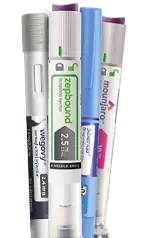
Storage rules are similar across GLP-1 pens but not identical, especially the number of days a product can sit at room temperature. Use this table as a quick reference, and defer to your product's own instructions if anything differs.
Medication (active ingredient) | Before first use | Once out of the fridge (room temperature) | Key rules |
Ozempic (semaglutide) | Refrigerate at 36 to 46 °F until the expiration date | 59 to 86 °F, use within 56 days of first use (or keep refrigerated and still use within 56 days) | Do not freeze; keep the cap on and protect from light |
Wegovy (semaglutide) | Refrigerate at 36 to 46 °F; if needed, may be kept at 46 to 86 °F for up to 28 days before use | Each single-dose pen is used once, then discarded | Do not freeze; keep in the original carton to protect from light |
Zepbound (tirzepatide) | Refrigerate at 36 to 46 °F | Single-dose pen or vial: up to 86 °F for up to 21 days; the single-patient-use KwikPen: up to 30 days | Do not freeze; protect from light; do not return to the fridge after room-temperature storage |
Mounjaro (tirzepatide) | Refrigerate at 36 to 46 °F | Single-dose pen or vial: up to 86 °F for up to 21 days | Do not freeze; protect from light; do not return to the fridge after room-temperature storage |
If you take a daily liraglutide injection such as Saxenda or Victoza, the pattern is similar but the room-temperature window is 30 days after first use, and freezing is still off-limits.
One habit ties all of these together: once a pen has been at room temperature, the clock is running, so write down the date you first used it (or first took it out of the fridge) and stop using it after that window closes, even if medication is left inside.
How Do You Know If Your GLP-1 Medication Shipment is Safe?
Open the box as soon as possible. Then run through a short checklist:
Confirm the package contains your medication at the correct dose.
Feel whether the cold pack is still cool and whether the pens themselves feel cold.
Look at the liquid. It should be clear and colorless, with no cloudiness, particles, or discoloration. If it looks off, don't use it.
If your shipment includes a temperature indicator, check it.
Unless you plan to inject right away, put the pens in the refrigerator promptly, and note the date you received them.
How Do You Store GLP-1 Pens at Home?
The refrigerator is the default home for unopened GLP-1 pens, with a couple of finer points:
Keep pens in the middle of the fridge, not in the door (where temperatures swing) and not pressed against the back wall or cooling element, where they can accidentally freeze.
Leave pens in their original carton to shield them from light.
Store them out of reach of children.
Track your first-use date and the product's room-temperature window so you know when a pen needs to be discarded.
Get prescription weight loss medication online.
Find out if you're eligible for GLP-1s, and get started on your weight loss journey for as low as $75/month.


How Do You Travel With Your GLP-1 Pen?
GLP-1 pens travel well as long as you protect them from extreme temperatures. On a plane, keep pens in your carry-on rather than checked luggage, since the cargo hold can get cold enough to freeze them. Use an insulated travel case. If you add a cool pack, avoid letting the pen sit in direct contact with it, so it does not freeze. Be sure to keep pens below 86 °F and out of direct sunlight, and never leave them in a hot car.
What Should You Do If Your GLP-1 Medication Arrives Warm, Hot, or Frozen?
If a shipment shows up warm, or you suspect the pens froze or sat above 86 °F for longer than the allowed window, don't use the medication and don't try to guess whether it's still good. The same goes for any pen whose liquid looks cloudy, discolored, or has particles in it. Contact the pharmacy or your provider, explain what happened, and ask about a replacement. A frozen pen should be discarded even after it thaws.
How Does LifeMD Ship GLP-1 Medications?
LifeMD coordinates fulfillment of authentic, FDA-approved, brand-name GLP-1 therapies through licensed U.S. pharmacies, with tracked shipping and real-time order updates.
If you're exploring GLP-1 treatment as part of your weight loss journey, LifeMD's Weight Management Program connects you with a licensed provider who can assess whether a GLP-1 is right for you, manage your prescription, track your progress, and adjust your plan as needed, all online. Your provider stays with you through the process, handling prescription refills and answering any questions, so you're never managing this alone.
Take the free assessment to see if you qualify.